When we lose a tooth, our immediate concerns are almost always aesthetic and functional. We worry about how our smile looks in photos, or whether we can still chew a steak comfortably. However, there is a hidden, sophisticated neurological consequence of tooth loss that most patients—and even many general practitioners—overlook: the disruption of the brain-tooth connection.
Every time you bite down on a piece of food, your teeth do not just mechanically crush it. They act as complex sensory organs, sending lightning-fast neural signals to your brain to calculate exactly how much force is required. This subconscious awareness of your jaw’s position and biting pressure is a neurological phenomenon known as proprioception, often referred to as your mouth’s “chewing memory.” When teeth are lost, this critical neurological feedback loop goes completely dark.
At Dr. Irfana’s Dental Studio in Jogeshwari West, Mumbai, we believe that premium restorative dentistry must go beyond superficial cosmetics. Led by Dr. Irfana Thanwala, a highly specialized Periodontist (MDS) and Implantologist with an esteemed Fellowship from the Indian Society of Oral Implantologists (ISOI), our studio focuses on bio-functional restoration. Modern dental implants do more than fill physical gaps; they actively help restore the jawbone matrix and stimulate neural frameworks, allowing your brain to reconnect with your bite.
Natural Teeth vs. Traditional Dentures vs. Dental Implants: The Neurological Breakdown
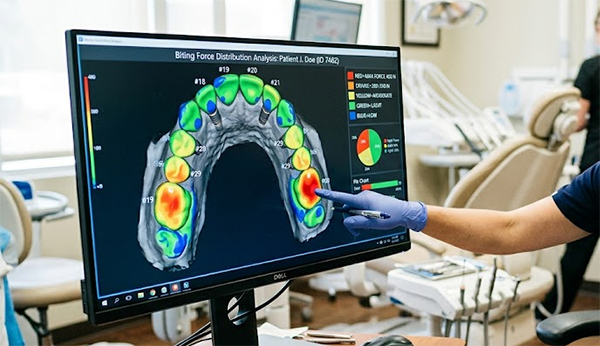
To understand how dental implants rebuild your subconscious chewing memory, it is essential to analyze how different dental structures communicate with the central nervous system:
| Neurological & Functional Feature | Natural Human Teeth | Traditional Removable Dentures | Advanced Dental Implants |
| Sensory Feedback Mechanism | Periodontal Ligament (PDL) fibers send instant, high-precision nerve signals. | Superficial pressure on oral tissues; completely lacks deep bone signals. | Osseoperception; direct bone-anchored nerve pathway restoration. |
| Biting Force Regulation | Subconscious, sub-micron precision to avoid fracturing enamel. | Zero precision; patients often accidentally bite too hard or too soft. | High adaptive precision; your brain relearns the structural force map. |
| Chewing Memory Recovery | Native state; fully intact. | Permanently lost; leads to clumsy jaw movements. | Gradually restored as the titanium post integrates into the bone. |
| Jaw-to-Brain Signal Speed | Milliseconds; fully automatic sensory-motor tracking loops. | Heavily delayed; relies entirely on external visual and tactile cues. | Near-natural velocity; re-establishes fluid, intuitive chewing habits. |
| Long-Term Cortical Mapping | Maintains an active, healthy neurological footprint in the brain. | Causes the brain’s sensory map for that tooth area to shrink over time. | Preserves and reactivates the brain’s localized neural pathways. |
The Science of Proprioception and Why Tooth Loss Triggers “Oral Amnesia”
Every natural tooth is suspended in its socket by a microscopic network of tissues called the Periodontal Ligament (PDL). The PDL is packed with highly sensitive mechanoreceptors—nerve endings specialized in detecting physical pressure.
When you chew, these mechanoreceptors act like structural sensors. If your teeth hit a hard particle (like a small stone in raw grain), the PDL instantly fires a distress signal to the central nervous system, triggering an involuntary reflex to open your mouth before your tooth fractures.
When a tooth is extracted, the PDL is completely lost. The brain suddenly loses its localized sensory input channel for that area. Over months of living with missing teeth, the neurological pathway begins to atrophy, causing a form of “oral amnesia.” The brain forgets how to precisely coordinate the muscles of mastication (chewing muscles) on that side of the mouth, forcing you to shift your jaw unnaturally to one side. This uncoordinated movement frequently leads to:
- Chronic tension headaches
- Unbalanced facial symmetry
- Severe wear and tear on remaining natural teeth
- Temporomandibular Joint (TMJ) disorders
How Dental Implants Re-engineer Your “Chewing Memory” Through Osseoperception
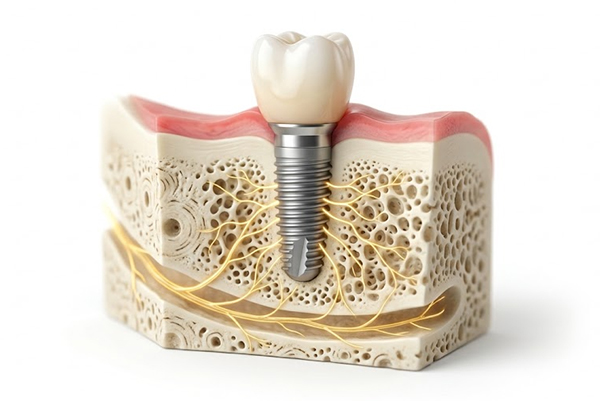
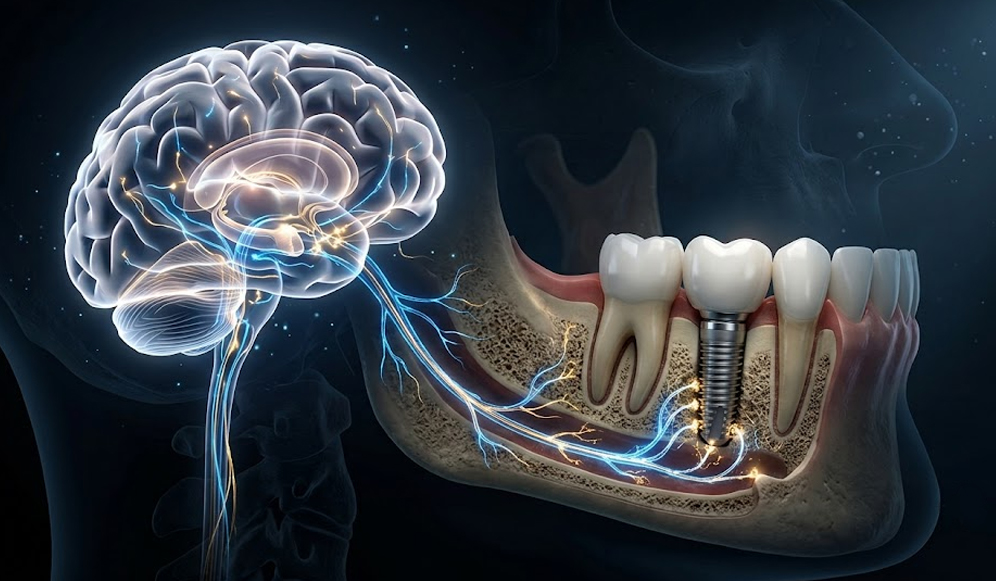
Because a dental implant is made of bio-compatible titanium, it undergoes a biological fusion process with your living jawbone called osseointegration. While an implant does not grow a brand-new periodontal ligament, something incredible happens inside the human body once integration is complete: a phenomenon known as osseoperception.
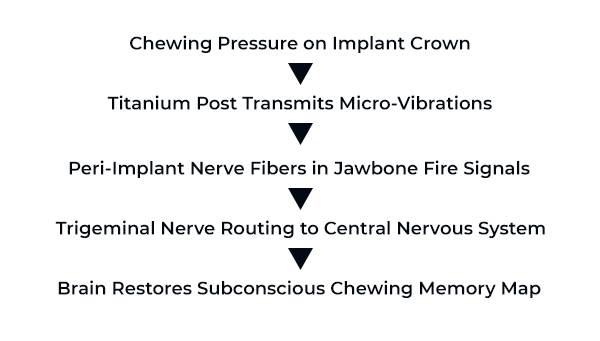
When you chew with an implant-supported crown, the mechanical forces travel directly down the titanium post and send subtle micro-vibrations into the surrounding jawbone matrix. Nerve fibers present within the bone tissues capture these vibrations and reroute the sensory signals up through the trigeminal nerve directly into your brain.
Over a few weeks of consistent use, the neural plasticity of your brain kicks in. Your central nervous system rewires its sensory-motor loop, adapting to these new signals. The brain successfully restores its “chewing memory map,” allowing you to bite, slice, and crush food with the same unthinking, automatic ease as your natural teeth.
The Strategic Neuro-Restoration Process at Dr. Irfana’s Dental Studio
Rebuilding a patient’s subconscious bite matrix requires an exceptionally meticulous, phase-based clinical approach to guarantee that the artificial components align perfectly with your body’s native biology:
Phase 1: Sub-Micron Precision Surgical Placement
Using advanced digital imaging systems at our Mumbai practice, Dr. Irfana Thanwala maps out the precise angulation and depth required for implant placement. The implant must be positioned exactly where the original tooth root sat to interface perfectly with the jaw’s underlying neural pathways. This precise execution lays the groundwork for high-quality osseoperception.
Phase 2: The Critical Healing and Bio-Fusion Intermission
During the initial months post-surgery, the titanium post remains completely undisturbed beneath the gum line. This quiet phase allows bone cells to weave directly into the microscopic pores of the implant surface. As osseointegration solidifies, new microscopic nerve endings naturally migrate toward the peri-implant zone, creating the hardware needed for the brain-tooth connection.
Phase 3: Neurological Calibration and Functional Loading
Once the structural foundation is secure, we attach a custom-engineered ceramic or zirconia crown. This crown is shaped using advanced software to match your exact natural occlusion (the way your top and bottom teeth fit together). When you begin chewing soft foods, your brain starts receiving its very first sensory signals from that area in months—or even years—initiating the neural calibration process that fully restores your subconscious chewing memory.
FAQs
Does a dental implant really feel exactly like a natural tooth when chewing?
While it lacks the soft, cushion-like sensation of a natural periodontal ligament, the phenomenon of osseoperception ensures that it feels incredibly close to a real tooth. Most patients report that within a couple of months of functional loading, they completely forget which tooth is the implant and which one is natural because the brain integrates the sensory feedback perfectly.
How long does it take for the brain to adjust and restore its “chewing memory”?
The physiological process of neurological adaptation—or neuroplasticity—varies by individual, but most patients begin to experience automatic, subconscious chewing patterns within 4 to 8 weeks after the final custom crown is permanently attached to the implant.
What happens to my jaw muscles if I leave a missing tooth space empty for years?
Leaving a missing tooth untreated causes your jaw muscles to work twice as hard on one side to compensate. Over time, this leads to muscle atrophy on the inactive side, structural changes in your jaw joint (TMJ), and the progressive deterioration of your jawbone matrix, making future restorations much more complex.
Can an incorrectly aligned implant crown damage my brain-tooth connection?
Yes. If an implant crown is even a fraction of a millimeter too high or misaligned, it sends improper, excessive force signals to the brain, which can cause localized bone stress, muscle fatigue, and premature mechanical wear. This is why getting your restorations designed by a certified, highly experienced implantologist is absolutely vital.
How can I get my bite and chewing comfort evaluated by an expert in Mumbai?
If you are struggling with missing teeth or uncoordinated jaw movements, you can easily book an advanced digital intraoral diagnostic evaluation and a specialized implantology consultation at our state-of-the-art facility. To plan your treatment journey, visit Dr. Irfana’s Dental Studio.
Disclaimer
This specialized oral health and neuro-dentistry guide is published strictly for educational and general informational purposes. It does not replace professional clinical examinations, advanced digital dental radiography, or personalized intraoral diagnostics. Always schedule an in-person diagnostic evaluation with a certified dental implant practitioner to safely assess your bone density, neuromuscular alignment, and general oral health status.