For many people dreaming of a brighter, straighter, and more symmetrical smile, one major fear holds them back: the worry that cosmetic dentistry will ruin their healthy natural teeth. Social media is filled with alarming videos showing teeth aggressively shaved down into tiny pegs before crowns or veneers are placed. Understandably, no one wants to sacrifice healthy tooth structure just for aesthetics.
Fortunately, modern cosmetic dentistry has moved far away from aggressive tooth reduction. Thanks to breakthroughs in Digital Smile Design (DSD) and ultra-thin ceramic materials, today’s smile makeovers focus on biomimetic preservation. Using Minimal-Prep Porcelain Veneers, cosmetic dentists can transform the shape, color, and alignment of your smile while keeping almost all of your natural tooth enamel completely intact.
At Dr. Irfana’s Dental Studio in Jogeshwari West, Mumbai, conserving your natural biology comes first. Led by Dr. Irfana Thanwala, a renowned Smile Designing expert, MDS Periodontist, and Implantologist with an elite Fellowship from the Indian Society of Oral Implantologists (ISOI), our studio uses precision digital planning to deliver breathtaking smile transformations with minimal to zero enamel removal.
Minimal-Prep Veneers vs. Traditional Restorations: The Enamel Preservation Breakdown
To see how modern techniques safeguard your natural teeth compared to older methods, review the clinical differences below:
| Cosmetic Dentistry Parameter | Traditional Crowns & Heavy Veneers | Modern Minimal-Prep Porcelain Veneers |
| Enamel Reduction Depth | Aggressive; often removes 1.0 mm to 2.0 mm of tooth structure all around. | Ultra-Conservative. Removes just 0.2 mm to 0.5 mm (as thin as a contact lens). |
| Primary Bonding Layer | Often cuts deep into the softer, inner dentin layer of the tooth. | Stays strictly within the hard, outer enamel layer for maximum strength. |
| Post-Treatment Sensitivity | Moderate to high risk of temporary or lingering hot/cold sensitivity. | Virtually Zero. Preserving enamel shields the inner nerve from temperature shocks. |
| Need for Local Anesthesia | Almost always required due to deeper tooth preparation. | Often requires minimal or no anesthesia because preparation is microscopic. |
| Digital Trial Preview | Limited; relies on hand-shaped temporary acrylics after drilling. | 3D Trial Smile placed before touching your natural teeth to guide exact prep depth. |
| Long-Term Structural Bond | Relies on mechanical grip over a heavily reduced tooth core. | Chemical fusion to pure enamel, creating a bond nearly as strong as a natural tooth. |
The Science of Enamel: Why Keeping Your Outer Layer Matters
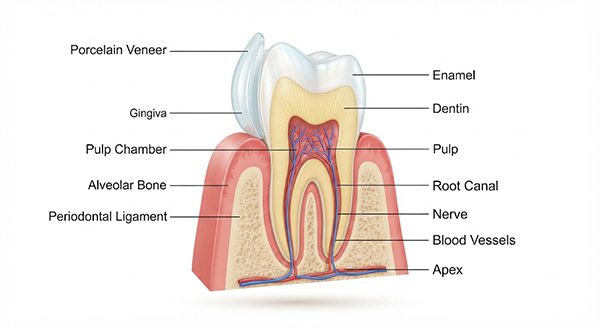
Tooth enamel is the hardest, most mineralized substance in the entire human body. Beneath this protective outer shell lies dentin, a softer, microscopic tubular tissue that connects directly to your tooth’s living nerve.
In older cosmetic procedures, dentists routinely drilled past the enamel into the dentin layer. Not only did this weaken the overall tooth, but bonding porcelain to softer dentin is far less predictable over time. Modern minimal-prep smile designing works on a completely different scientific principle: enamel-driven adhesion.
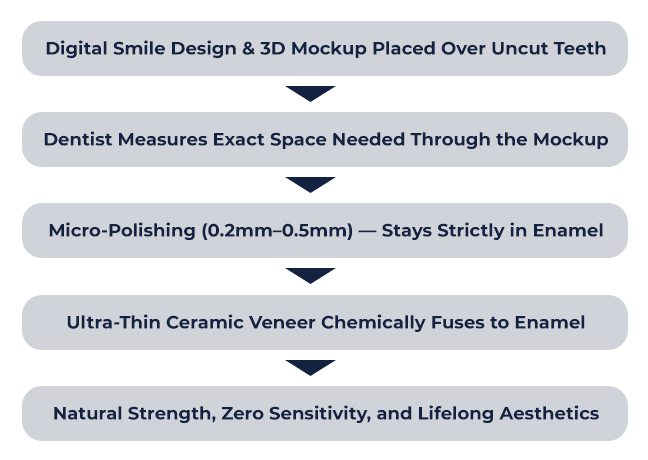
When porcelain is bonded strictly to healthy enamel, a powerful micromechanical and chemical fusion occurs. The ultra-thin ceramic layer essentially replaces the microscopic fraction of enamel polished away, restoring 100% of the tooth’s original structural rigidity while protecting the sensitive inner dentin from bacteria and temperature changes.
How Digital Smile Design Eliminates Over-Drilling
The secret to preserving your natural enamel lies in planning the final result before any dental instrument ever touches your teeth. When a dentist knows the exact thickness of the final porcelain veneer ahead of time, they never have to guess how much tooth structure to smooth down.
At Dr. Irfana’s Dental Studio in Jogeshwari West, we protect your teeth through a precise, four-step conservative workflow:
- 3D Intraoral Optical Scanning: We capture a high-definition digital 3D model of your teeth and gums, mapping every natural ridge and angle with sub-millimeter accuracy.
- Virtual Facial Mapping: Using Digital Smile Design software, we design your ideal tooth proportions based on your lip line, facial symmetry, and natural expressions.
- The “Additive” Trial Smile Mockup: Before preparing your teeth, we place a temporary 3D-printed mockup directly over your uncut enamel. If your teeth are slightly small, spaced apart, or tilted inward, adding porcelain outward means virtually zero enamel needs to be removed.
- Depth-Guided Micro-Preparation: When minor smoothing is needed to prevent bulky edges, Irfana Thanwala uses calibrated depth-cutter burs directly through the mockup. This guarantees that only the exact microscopic fraction of enamel required is gently polished away.
FAQs
Do porcelain veneers permanently ruin your natural teeth?
No, not when performed using modern minimal-prep techniques. While removing 0.2 mm to 0.5 mm of enamel is irreversible (meaning the tooth will always need a protective veneer or bonding cover), your underlying tooth remains completely healthy, strong, and alive underneath.
What is the difference between Minimal-Prep Veneers and “No-Prep” Veneers?
“No-prep” veneers require zero enamel smoothing and are placed directly over existing teeth. While ideal for people with gaps or naturally small teeth, placing no-prep veneers on teeth that are already prominent or crowded can make them look bulky. Minimal-prep veneers involve gentle micro-polishing so the final smile looks sleek, natural, and never thick.
Does tooth enamel grow back once it is polished for a veneer?
No. Human tooth enamel does not contain living cells, so it cannot regenerate once removed. That is precisely why choosing a conservative cosmetic specialist who relies on digital mockups and minimal-prep protocols is essential to preserving your long-term dental health.
Will my teeth feel sensitive to cold water after minimal-prep smile designing?
Because minimal-prep protocols keep the preparation strictly within the outer enamel layer without exposing the sensitive inner dentin, post-procedure sensitivity is rare. Any mild temperature awareness typically settles completely within a few days once the permanent porcelain veneers are bonded.
How can I explore enamel-safe smile designing in Mumbai?
If you want to enhance your smile without compromising the health and strength of your natural teeth, a digital smile consultation is the safest place to start. To schedule an advanced 3D intraoral scan and preview your future smile with Dr. Irfana Thanwala, visit Dr. Irfana’s Dental Studio.
Disclaimer
This specialized guide on cosmetic dentistry and enamel preservation is published strictly for educational and general informational purposes. It does not replace professional clinical intraoral examinations, enamel thickness evaluations, or personalized dental radiography. Always schedule an in-person consultation with a certified cosmetic dentist to safely assess your tooth alignment, bite forces, and suitability for minimal-prep veneers.