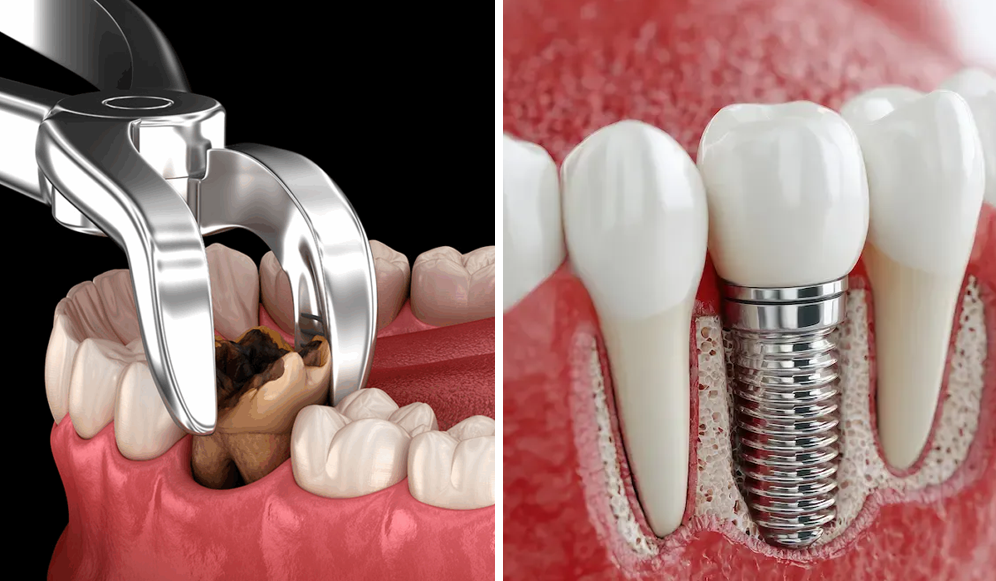
For generations, the standard sequence for replacing a severely damaged or non-salvageable tooth followed a rigid, multi-stage timeline. A patient would undergo a tooth extraction, endure a lengthy healing intermission of three to six months while the empty socket closed, and only then return to the clinic to have a dental implant post surgically placed. While this traditional method remains highly successful, it forces the patient to undergo two separate surgical phases and live with a conspicuous, uncomfortable gap in their smile for half a year.
Modern restorative dentistry has completely revolutionized this timeline through a specialized procedure known as Immediate Dental Implant Placement. This approach allows a highly trained clinician to carefully extract the failing tooth and place a permanent titanium implant post into the fresh extraction socket during the exact same appointment.
Beyond the obvious convenience of saving time and cutting down on clinic visits, getting an immediate implant offers massive biological and anatomical benefits. It works in perfect harmony with your body’s natural post-extraction healing patterns, preserving bone density and maintaining youthful facial aesthetics.
At Dr. Irfana’s Dental Studio in Jogeshwari West, Mumbai, our practice focuses on bio-functional preservation. Led by Dr. Irfana Thanwala, an expert Periodontist (MDS) and Implantologist with an elite Fellowship from the Indian Society of Oral Implantologists (ISOI), we use advanced 3D diagnostics to utilize fresh extraction sites safely, keeping your natural bone matrix fully intact.
Immediate Implants vs. Traditional Delayed Implants: The Healing Timeline Breakdown
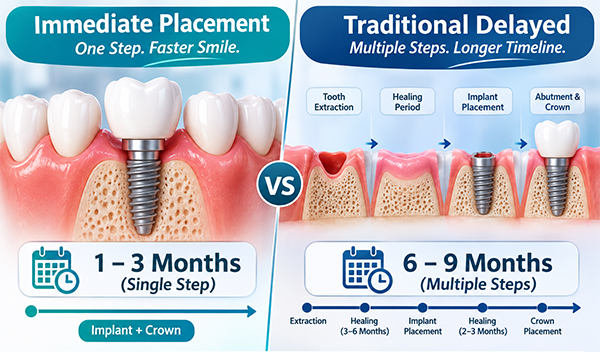
To understand how immediate loading alters your recovery, let us compare the biological and structural milestones of both methods side by side:
| Clinical Restoration Parameter | Immediate Dental Implant Placement | Traditional Delayed Implant Placement |
| Surgical Phase Count | Single Session. Extraction and implant placement happen together. | Two separate surgical procedures spaced months apart. |
| Alveolar Bone Loss Prevention | Exceptionally High. The titanium post instantly stops bone resorption. | Moderate to Poor. The empty socket naturally shrinks and loses width. |
| Gum Tissue Contour Maintenance | Preserves your natural, rounded pink gum line around the crown. | The gum line often flattens, requiring complex grafting later. |
| Total Functional Treatment Time | Shortened by 3 to 6 months. Total recovery is much faster. | Lengthy; often requires 6 to 9 months from start to finish. |
| Microscopic Healing Mechanism | Combines socket blood clot formation with direct bone remodeling. | Relies entirely on secondary bone healing before drilling a new site. |
| Psychological Patient Impact | High comfort; avoids spending months with an embarrassing gap. | Temporary appliances can feel clumsy, loose, or awkward. |
The Bone Biology: Stopping the “Shrinkage Effect” in Its Tracks
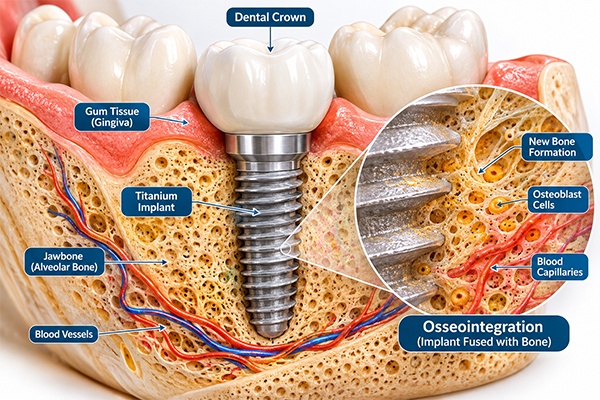
To fully appreciate the biological power of immediate implants, you must understand what happens to your jawbone the moment a tooth is removed. Your jawbone is a highly dynamic organ that exists solely to support your teeth. The part of the bone holding the tooth socket is called the alveolar ridge.
Every time you chew, your natural tooth root transmits microscopic physical forces down into this alveolar bone. This physical stimulation acts like a biological signal telling your body to constantly pump fresh blood, nutrients, and calcium to that specific area.
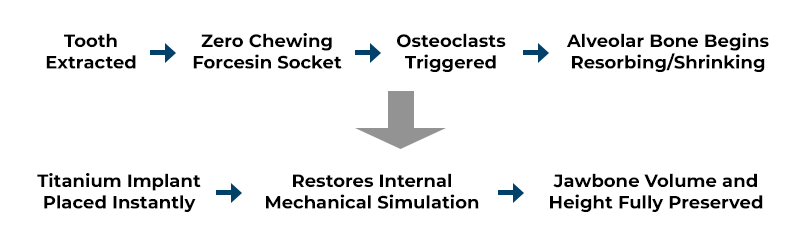
When a tooth is extracted, that mechanical signal goes completely silent. Recognizing that the bone is no longer supporting a functional root, your body triggers specialized cells called osteoclasts to break down and reabsorb the unused bone tissue.
Clinical research shows that within the first 6 to 12 months after a tooth extraction, your alveolar ridge can lose up to 40% to 60% of its total width and height. This rapid bone loss can give your cheeks a sunken look and make future implant placement much more complex.
Placing a titanium implant post into the socket immediately after extraction completely disrupts this degenerative breakdown. The titanium post acts as an artificial root, filling the empty space and instantly restoring internal mechanical simulation to the surrounding bone walls. This biological trick preserves your jawbone’s volume, shape, and height.
Preserving the Aesthetic Framework: Keeping Gums Look Natural
When an empty socket is left to heal on its own for months, it doesn’t just lose bone underneath; the surrounding soft pink gum tissue collapses inward as well. The delicate, curved gum tissue between your teeth-known as the interdental papillae-often flattens out permanently.
If you try to place a dental crown over a flattened gum line months later, the tooth can end up looking uncharacteristically long, or it can leave an awkward, dark gap near the gum line called a “black triangle”.
An immediate implant acts as a physical scaffold that supports these delicate gum contours from day one. By holding your natural gum tissues in their original, rounded architecture during the healing phase, the final prosthetic crown emerges from the gums looking incredibly natural—indistinguishable from a real, healthy human tooth.
Advanced Immediate Diagnostic Frameworks at Our Mumbai Studio
Placing an immediate dental implant requires immense surgical skill and an advanced digital infrastructure. At our state-of-the-art practice in Jogeshwari West, Dr. Irfana Thanwala utilizes a safe, highly strategic clinical protocol:
- High-Resolution CBCT 3D Evaluation: We use 3D cone-beam computed tomography to evaluate the health of your bone walls before extraction. An immediate implant is safe only if the underlying bone socket is structurally intact and free of acute infections.
- Atraumatic Periotome Extraction: Traditional tooth extraction techniques can fracture delicate surrounding bone walls. We use microscopic instruments called periotomes to gently slide the tooth out without damaging the structural socket.
- Primary Stability Anchor Calibration: Using digital surgical torque motors, we secure the implant deep into the healthy bone base located just below the old tooth socket. This creates strong initial stability, which is vital for the implant to heal securely.
- Biocompatible PRF/Bone Graft Co-Augmentation: If there is a small structural gap between the new implant post and your natural socket walls, we fill it with specialized bone-building materials or platelet-rich fibrin (PRF) to accelerate your body’s natural cell regeneration.
FAQs
Can any damaged tooth be replaced with an immediate dental implant?
Not every case qualifies for an immediate implant. The site must be completely free of severe, active bacterial infections or large pus abscesses. Additionally, the bony walls of the tooth socket must be thick and structurally intact to support the new titanium post securely from day one.
Is the surgery for an immediate dental implant more painful than a traditional extraction?
No. The entire procedure is performed under deep, precise local anesthesia, meaning you will feel zero pain during the treatment. Because the extraction and implant placement are combined into a single session, you only have to heal once, which often results in less overall post-operative discomfort.
Do I leave the clinic with a visible crown on the same day as my immediate implant?
In many cases, yes. If your implant achieves excellent initial stability in the bone, we can attach a lightweight, temporary aesthetic crown during the same visit. This temporary crown is crafted purely for looks and is designed to stay completely out of contact when you bite down, allowing the bone to heal undisturbed.
What happens if I choose to wait too long after a tooth extraction to get an implant?
If you wait longer than 6 to 12 months, your jawbone will naturally shrink and lose volume. If severe bone loss occurs, you cannot simply place an implant right away. You will first need to undergo an extra, costly bone-grafting surgery or a sinus lift to rebuild the lost foundation before an implant can be safely anchored.
How can I get my damaged tooth evaluated for an immediate implant in Mumbai?
If you are facing a tooth extraction and want to avoid living with a missing gap, acting quickly is vital. To book an advanced digital 3D intraoral evaluation and explore your immediate tooth replacement options with our clinical team, visit Dr. Irfana’s Dental Studio.
Disclaimer
This specialized guide on oral bone biology and immediate dental implantology is published strictly for educational and general informational purposes. It does not replace professional diagnostic evaluations, emergency clinical diagnostics, or personalized intraoral radiography. Always schedule an in-person assessment with a certified dental practitioner to safely diagnose your bone density, tooth stability, and systemic suitability for immediate surgical treatments.